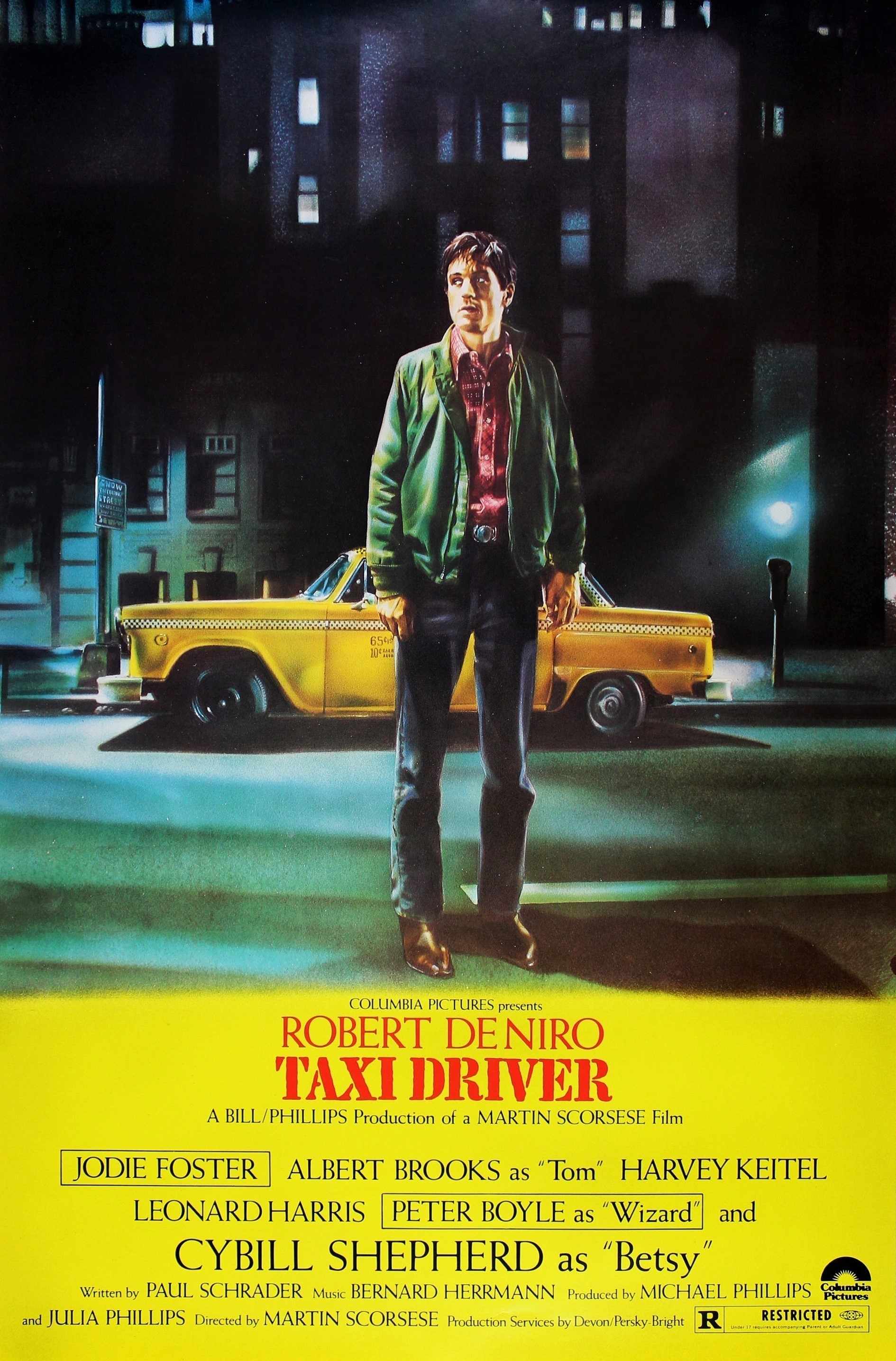
Taxi Driver (1976)
written by Paul Schrader
directed by Martin Scorsese
I watched Taxi Driver for the first time when I was around fifteen. I was completely blown away by everything in it, from the overall narrative by writer Paul Schrader – Travis Bickle (Robert De Niro), an emotionally unstable Vietnam vet working as a cabbie in New York City, decides to stand up “against the scum, the cunts, the dogs, the filth, the shit” and goes on a violent rampage – to director Martin Scorsese‘s way of telling it: Slo-motion shots, jump cuts, long takes, and natural lighting, all influenced by his love of French New Wave and an evolution of the same techniques he employed in the earlier Mean Streets (1973). Taxi Driver is a dreamlike descent into madness that’s easily one of the best films of the era.
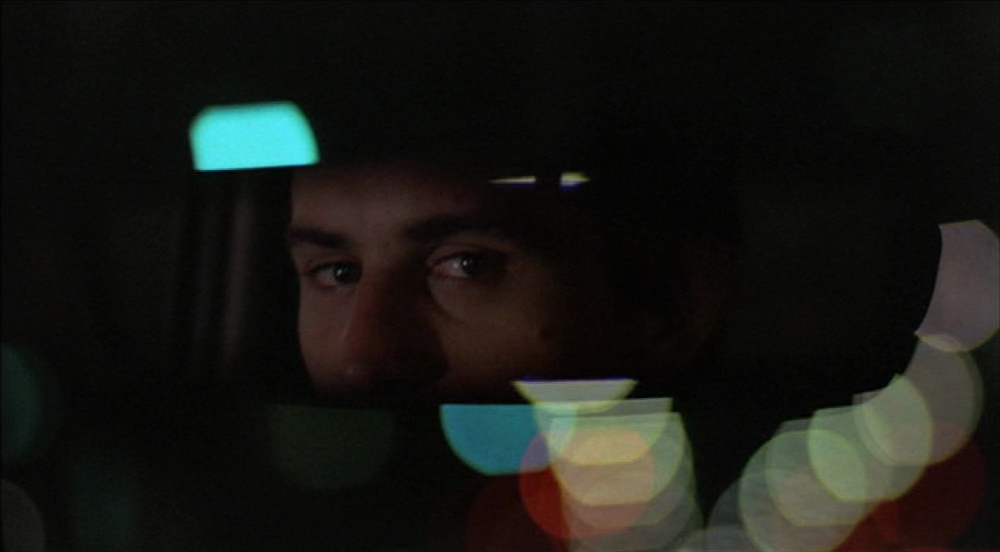
Watching it yet again (this is probably my sixth time), I’m reminded of all the creative decisions that make it so memorable. Bernard Herrman’s score alternates between a menacing military theme to a jazzy saxophone motif that serves as support to both Travis’ anger and his loneliness; Michael Chapman’s gritty, hypnotic cinematography; the way De Niro can improvise a line like “You talkin’ to me?” and immediately make movie history. And then of course there’s the brutal climax in which Bickle, attempting to rescue a young prostitute (Jodie Foster), massacres a pimp (Harvey Keitel) and his buddies, a sequence that had to be desaturated so that the MPAA wouldn’t give the film an X rating. Add an ambiguous ending in which either Travis becomes a lauded hero or he imagines himself to be one as he dies, and you’ve got one of Scorsese’s most complete artistic achievements.
For me, two particular scenes are at the heart of Taxi Driver‘s genius – and I say this knowing full well that the movie is replete with memorable ones. The first happens halfway through, as Travis, starting to feel he’s about to have a breakdown, asks fellow driver Wizard (Peter Boyle) for advice. As they both walk out of a diner, Travis confides, with visible difficulty, that he’s“…got some bad ideas in my head.” It’s heartbreaking; you can feel the confusion, the agony of a mind clearly reeling and asking for help. De Niro’s performance is phenomenal as he desperately tries to connect to another human being, yet is all but ignored by Wizard, who doesn’t have the emotional intelligence to realize what’s going on.
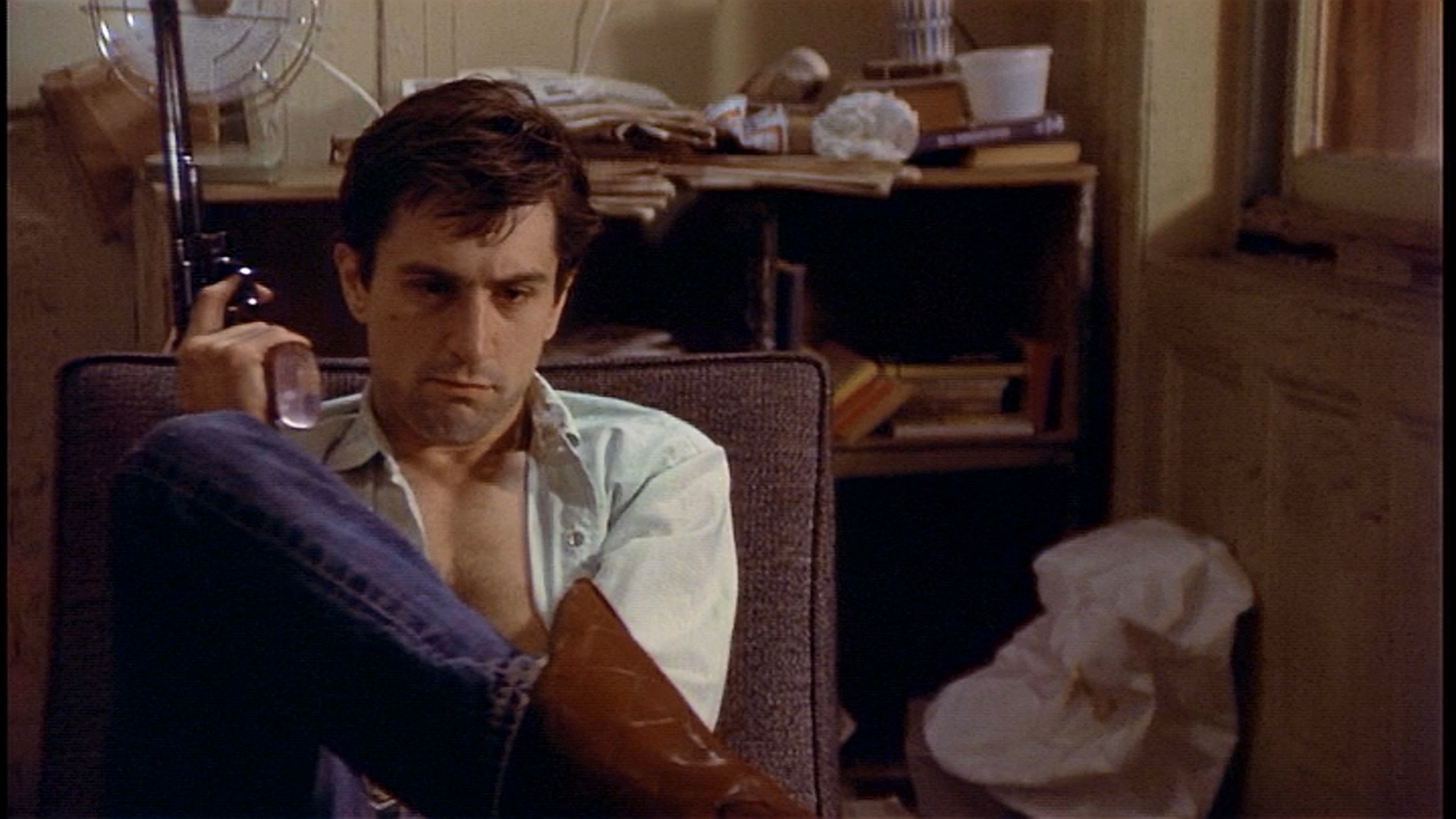
The second scene takes place immediately after Travis, having already gone over the edge and killed a burglar at a convenience store, stares blankly at American Bandstand on the TV. As people dance to an unknown song, Scorsese plays Jackson Browne’s Late for the Sky on the soundtrack, pushing in on Travis as we hear the lyrics, “How long have I been sleeping? How long have I been drifting alone through the night?” Making this moment even more poignant is Travis’ focus on a pair of shoes left behind on the dance floor, a symbol of his own isolation and disconnection from the world… and in De Niro’s hands, an indelible portrait of mental illness.
In his 2004 review of Taxi Driver, Roger Ebert said that it was “…a film that does not grow dated, or over-familiar. I have seen it dozens of times. Every time I see it, it works; I am drawn into Travis’ underworld of alienation, loneliness, haplessness and anger.” I couldn’t agree more. This is a masterpiece of American cinema.
Rating: ****
Carlos I. Cuevas
Categories: Action, Drama, Movies, Noir/Neo-noir
 A F T E R I M A G E